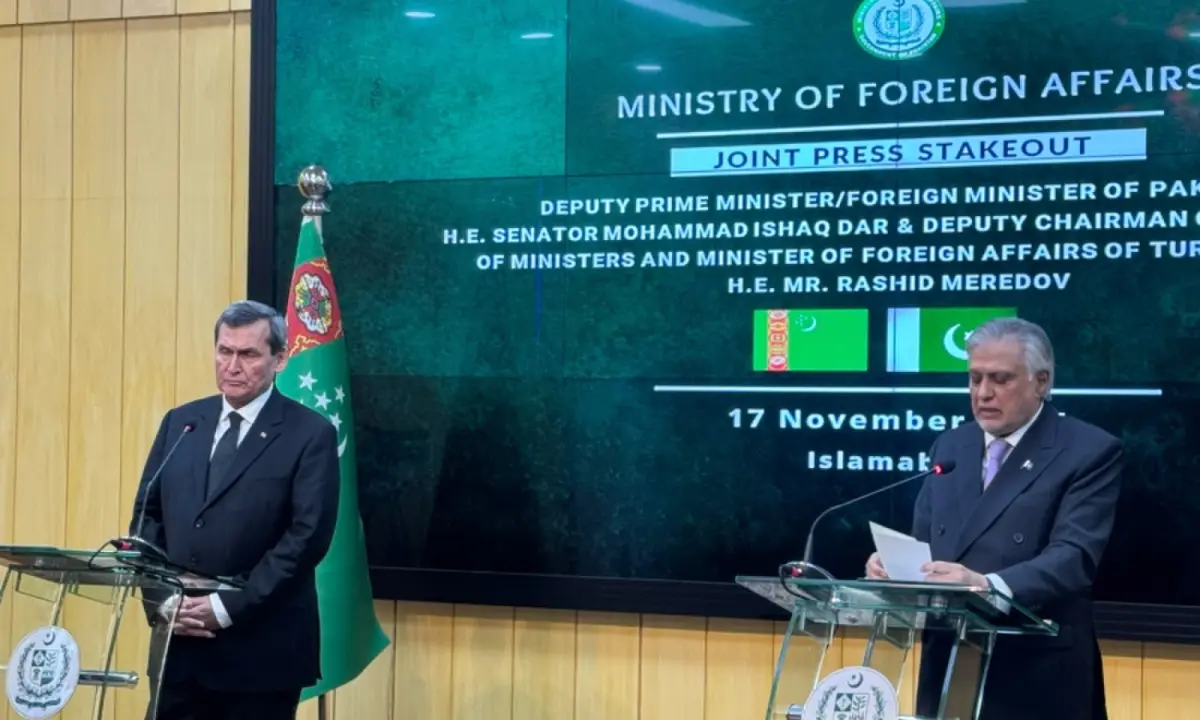
KARACHI / ISLAMABAD — Pakistan and Turkmenistan have agreed to convene an upcoming meeting of the steering committee for the long-planned Turkmenistan-Afghanistan-Pakistan-India (TAPI) natural gas pipeline. The decision emerged on Tuesday during high-level diplomatic engagements at the 6th Session of the Pakistan–Turkmenistan Joint Intergovernmental Commission (JIC) hosted in the federal capital.
During a joint press stakeout following the negotiations, Deputy Prime Minister and Foreign Minister Ishaq Dar highlighted that both delegations emphasized maintaining active political engagement regarding the technical and commercial dimensions of the infrastructure undertaking. The discussions occurred alongside a visit by Turkmenistan’s Foreign Minister Rashid Meredov, who arrived in the country ahead of the 30th meeting of the Economic Cooperation Organisation Council of Ministers.
The multi-billion-dollar, 1,800-kilometre regional energy corridor is designed to transport 33 billion cubic metres of natural gas every year from Turkmenistan's Galkynysh gas field—recognized as the world's second-largest—to the Indian border city of Fazilka. The planned route traverses Herat and Kandahar in Afghanistan, as well as Quetta and Multan in Pakistan. The initiative involves an initial free-flow phase estimated between $5 billion and $6 billion, supplemented by at least $1.9 billion allocated for compressor station installations.
Bilateral ties between Islamabad and Ashgabat have seen formal steps toward broader integration, building on a joint implementation plan signed in June 2023 and subsequent developments announced by Afghan authorities in September 2024. Concluding the latest diplomatic round, both governments formally signed the JIC 6th Session protocol, a Programme of Cooperation for their respective foreign ministries spanning 2026 to 2030, and a memorandum of understanding aimed at boosting tourism collaboration.